 Written by
 Most companies don’t have a data problem. They have a growth problem that shows up as a data problem.
On this page
You might experience your business getting bigger and more complicated without your information systems keeping up with it. Reports that used to agree now disagree. A number takes three days and two Slack threads to produce. A decision gets made on a figure that turns out to be a month stale. A data consultancy is who you call when that gap between how fast the business moves and how well its data keeps up starts costing you real money.
What is data consulting?
Data consulting is bringing in outside specialists to make an organisation’s data usable; reliable enough to trust, fast enough to act on, and shaped so people can actually answer questions with it. In practice that spans four connected disciplines:
- Data engineering: the plumbing. Pipelines that move data from where it’s created (your app, your customer relationship management (CRM) platform, sensors, third-party application programming interfaces (APIs)) into one place, cleaned and consistent, so everything downstream draws from the same source of truth.
- Analytics and business intelligence: turning that data into dashboards, metrics and answers. Less “here is a chart” and more “here is the number leadership argues about, defined once, computed the same way every time.”
- Machine learning and AI: using the data to predict and automate: forecast demand, flag fraud, score leads, read free-text at scale, put a language model in front of a database so people can just ask it questions.
- Cloud architecture: where all of the above runs. Getting the storage, compute and cost structure right so the system scales with the business instead of buckling or quietly overbilling you.
A good consultancy doesn’t treat these as separate products. The engineering exists to make the analytics trustworthy; the cloud choices exist to make both affordable.
Why you need data consulting
The root cause is almost always the same: the business outgrew its information infrastructure.
Early on, everything is small enough to hold in your head. One database, a few spreadsheets, someone who knows where things are. Then you grow. You add a product line, a region, an acquisition, three new tools that each store their own version of “the customer.” Nobody sat down and designed the result. It grew on its own, unkept. And unkept systems generate friction:
- Decisions slow down because getting a straight answer means reconciling three systems that half-agree.
- Decisions get made wrong because someone acted on data that was incomplete, stale, or plainly incorrect (and didn’t know it).
- People stop trusting the data is the most expensive failure of all. Once leaders suspect the dashboard, they fall back on gut instinct, and you’re paying for a data team whose output nobody uses.
None of this shows up as a line on the cost sheets, which is exactly why it festers. The cost is diffuse (an hour here, a bad call there), until it isn’t.
How can a consultancy help?
A data consultancy’s job is to close that gap between information and organisation instead of letting it keep widening. Concretely:
- Find one source of truth. Consolidate the conflicting systems so a given metric has one definition and one place it’s computed. Most “our numbers don’t match” problems are definition problems, not maths problems.
- Build pipelines that don’t rot. Move data automatically, test it in flight, and fail loudly when something upstream breaks, so you learn from an alert, not from a wrong board slide.
- Make the right thing fast and the wrong thing hard. Model and index the data so common questions return in milliseconds and are difficult to compute incorrectly.
- Apply machine learning (ML) where it pays. Not AI for its own sake. A forecast, a classifier or an automation aimed at a specific decision that’s currently manual, slow, or guessed.
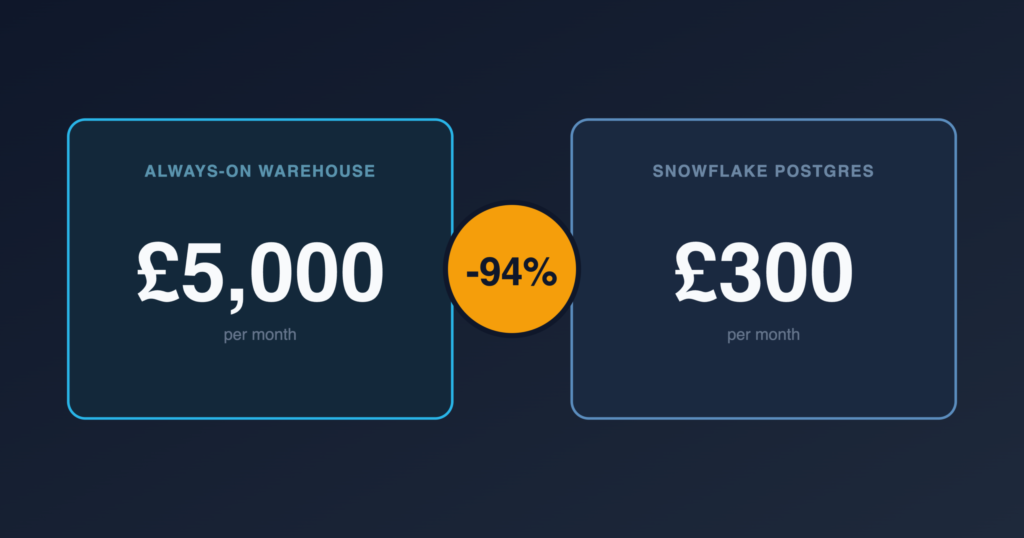
- Right-size the infrastructure. Match the architecture to the actual workload so you’re not paying premium rates for the wrong kind of work.
The good ones also leave you better off than they found you: documentation, handover, and a team that understands what was built; not a black box you have to re-hire them to touch.
Signs that you need help with your data
You probably need outside help if more than one of these sounds familiar:
- Two teams pull “the same” number and get different answers and a meeting gets spent on whose is right instead of what to do.
- Simple questions take days. “How many active customers in the north region last quarter?” shouldn’t require an engineer and a fortnight.
- Analytics projects start but never ship. Proofs of concept pile up; nothing reaches production or changes a decision.
- Leadership runs on gut because the data isn’t trusted enough to run on instead.
- Your cloud bill keeps climbing with no matching growth in what you’re getting for it.
- One person is a single point of failure: the whole data operation lives in one head, and you hold your breath when they take leave.
One of these occasionally is normal. Three of these is a tax you’re paying every week.
Key questions to consider
Before you hire, get these straight internally first, then with the consultancy:
- What decision should change? Scope to an outcome (“we want to forecast churn well enough to act on it”), not a technology (“we want a data lake”). Tools follow decisions, not the other way round.
- Who’s the sponsor? Data work crosses departments and dies without a senior owner who can unblock access and adjudicate disputes. Name that person before day one.
- Do they hand over, or create dependency? Ask directly how a project ends. You want documentation, knowledge transfer, and the option to run it yourself (not a permanent charge running).
- Can they show the work? A real track record means specifics: what they built, the numbers it moved, what didn’t work. Be wary of anyone who only speaks in transformation and synergy.
- Will they tell you when the answer is “don’t”? The most valuable advice is often “you don’t need the expensive thing.” A consultancy that never talks you out of scope is selling, not advising.
- Do they fit your team? They’ll sit inside your workflows for weeks or months. Technical skill is necessary; being someone your engineers actually want in the room is what makes it work.
The skills FloreData brings
FloreData is a data and AI consultancy built with a people-first mindset. Through 20+ years of project time, we have experienced how the best technology still fails when users are left out of the equation. That shapes how we work: we listen carefully and communicate effectively with our clients, because we have seen what happens when you don’t.
The team is deliberately full-stack across the disciplines above, covering:
- End-to-end data platforms
- Data pipelines
- Production ML
- AI deployment
- Business intelligence and dashboards
- Systems and infrastructure
- Cloud modernisation and cost savings
See our case studies and services page for more.
We’re built to be an extension of your team rather than an outside vendor that appears, presents, and vanishes. No agency ego, no gatekeeping, no jargon used to keep you dependent. As one client put it, we “felt like an extension of [their] own technical team.” For a lot of companies that’s the real value: your data team, without the full-time hire, and the mess untangled before it costs you another quarter of decisions made on numbers you can’t quite trust.
FloreData is a data and AI consultancy. If your growth has outrun your data, start a conversation.